Hearts and Minds: An Ambivalent Review of “Project Hail Mary”
“I try to be scientifically accurate. That’s my whole shtick.”
—Andy Weir
“You Keep Using That Word. I Do Not Think It Means What You Think It Means.”
—Inigo Montoya
“We don’t need other worlds. We need mirrors.”
—Stanislaw Lem, Solaris
Lers of Spoi.
You Have Been Warned.
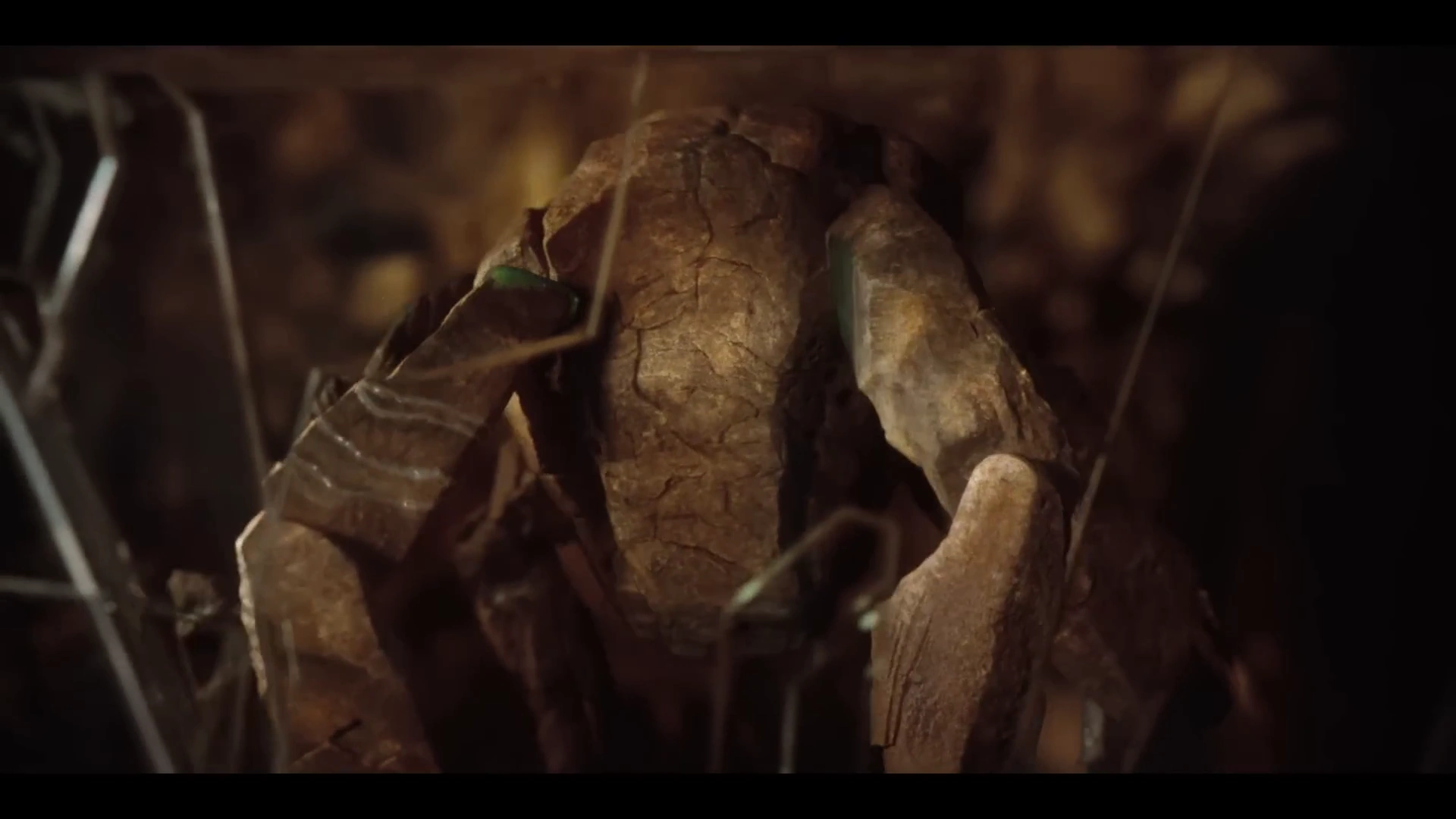
As the credits rolled at the end of “Project Hail Mary”, I turned to the The BUG and said “Well, another story where the alien turns out to be a human in a rubber suit.” The BUG shook her head: “Not a Human. A smart goofy golden retriever.”
We weren’t talking about morphology, of course. We’re decades past the point where movies had to put actors in rubber suits to portray aliens. But intellectually. Psychologically. Rocky—an anaerobic, blind, echolocating smart exoskeleton hosting a colony of alien microbes from Vulcan 40 Eridani—turns out to be just a guy super-smart golden retriever. The vastly different environments of Erid and Earth—the radically different morphologies of the life that evolved on each world—have somehow converged on the same overall personality template. I’ve encountered Republicans with a more alien mindset than Rocky.
I hesitate to admit this, but I actually liked this movie quite a bit the second time I saw it. (The first time, I thought it was the most scientifically-illiterate pro-science polemic I’d ever seen. I calmed down a bit for the rewatch.) It does a number of things very well. The first act nails the sense of isolation, of loneliness in an infinite void. Ryan Ghosling as Ryland Grace is, as always, a sympathetic protagonist. Making him a sniveling coward who has to be dragged kicking and screaming into a suicide mission is a refreshing departure from the usual Hollywood hero who stoically accepts his fate for the sake of Humanity. The music soundtrack works way better than it has any right to. Space is mercifully silent: a small detail, but one that so very few movies have ever bothered to respect. The movie is never boring. It at least pretends to care about science, unapologetically portrays the scientific process as a good thing, something that works, bitches. Christ knows that’s a message that needs as big a megaphone as you can find these days.
The movie also undercuts that position by seemingly regarding its target audience as a bunch of incurious imbeciles who’d rather be coddled than challenged.
Speaking as one of the few modern authors—maybe the only other?[1](nope. Just one of the few)— to have published a story about alien life-forms taking up residence in the sun[2] (right down to consequent Earthly perils due to solar cooling), I feel at least partially qualified to weigh in on the movie even though I haven’t read the novel. I have, at least, gone down a variety of rabbit holes exploring the scientific underpinnings of Project Hail Mary (we cite the novel using italics; when talking about the movie, “quotes”). I have read/watched pieces both gushing and dispassionate, ranging from the credible (a piece in the New York Times) to the sloppy (a “A PhD-Level Breakdown of Every Organism, Equation, Material, Scene, and Production Decision”, which appears to have been written by an LLM). I have a sense of which elements from Project Hail Mary made it into “Project Hail Mary”, and—more tellingly—which ones didn’t.
Movie first. Consider the main driver of the plot: a microbe composed “almost entirely of water” whose natural habitat is—wait for it—the surface of the sun. Also the atmosphere of Venus; it actively navigates between the two in the kind of ongoing feeding-ground/breeding-ground migration you’d see in humpback whales. (Hell, for all we know it lives on humpback whales too; the movie has the little buggers bopping around on Earth without any trouble.)
The movie recognizes the fundamental absurdity of this. Grace is recruited to the Hail Mary project because of his theories about non-water-based life, which the alien microbe clearly must be because “It lives on the surface of the sun. Does that sound like a water-based life form to you?” Soon enough we discover that astrophage is, in fact, water-based. Which should, as the movie has already acknowledged, be absolutely impossible for a denizen of the solar photosphere.
The movie never acknowledges the paradox. The whole question of how an astrophage can live where it does is never answered, never even mentioned again.
They could have answered it. Weir did, in the novel. His answer wasn’t perfect. He pulls something called “super cross-sectionality” out of his ass: a property that, instantiated in a cell membrane, traps neutrinos (which can then be harnessed as an endogenous power source and heat sink) and which is “opaque to all radiation”. Super-cross-sectionality is the secret sauce that allows astrophages to stay just below the boiling point of water no matter where they are.
Given that your average neutrino can’t be bothered to even notice when it’s passing through the mass of an entire planet, we’re clearly talking one magical membrane here, and you know what? I’ll give him that, even though the premise makes as much sense as saying Hey, these flatworms are just like the ones we have on Earth except they evolved with microscopic fusion reactors inside ’em. SF is full of things that don’t exist (or at least, haven’t been discovered yet) in service of a good story. Intrinsic fields. Warp cores and jump gates. Alderson drives. Hell, I’m probably gonna pull some kind of fictitious particle out of my own ass to keep the Sunflowers stories consistent (if any of the cosmologists I’ve reached out to ever get back to me, that is).
Now, once you’ve invented new rules—no matter how batshit—you’re obligated to follow them, at least if you purport to be writing “Hard SF”. That’s the point of the whole exercise: posit a scenario, play out the logical consequences. If astrophages are opaque to all forms of radiation, then they’re perfectly shielded; which is to say, they’re perfectly blind. There’s no way to navigate to Venus without opening the windows at least a crack, and the moment you do that anywhere near the sun you’re (very badly burned) toast. The same miracle that enables one facet of astrophage biology excludes another.
Again: I’ve not read the novel. It’s possible that Weir had an answer to that too, one the essays and videos I’ve digested simply didn’t mention. But even if he did screw that particular pooch, at least the dude put some thought into it. Not a great solution, but at least the problem wasn’t completely ignored in the book.
So, having already highlighted the issue in the screenplay, the producers could have spared a line or two of dialog to slot in Weir’s solution. Apparently, though, questions like Wait a second…how does a eukaryotic cell survive on the surface of the sun? were considered too trivial, too irrelevant, to warrant mention in the adaptation. The audience won’t care, the studio seemed to be thinking. The audience will be bored. The audience is too dumb to even ask the question.
And the studio was right. I’ve read no shortage of raves about “Project Hail Mary”. Many of them focus on how accurate its science is; Weir himself has spoken often and at length about the research he did, the equations he solved, how very rigorous the whole production is. There’s a market for intelligent hard science fiction, people are saying. We’re not niche any more. “PHM” proves it.
I beg to differ.
I could witter on about this or that technical error showing that “PHM”’s producers didn’t do their Hard-SF homework (How can Rocky parse videos on a flatscreen when its echolocation needs 3D topography to bounce off? How can the Hail Mary make it past 90% lightspeed when blueshift ablation would have melted the whole ship to slag at less than half that speed? How could Grace plot an intercept course to Rocky’s ship without even knowing what masses to scribble on his white board?). But my problem with the movie is more fundamental, more—philosophical—than a list of technical gripes.
Put simply: I don’t think people love this movie because it’s Hard-SF. They love it because it’s comforting. It feels good. And while I don’t have any objection to feel-good movies in principle, “Project Hail Mary” brands itself as far more than that, and I fear the brand suffers as a result.
Which brings us back to Rocky.
Rocky is, biologically, a mindblowingly imaginative creation. I’d put it on a par with the aliens in Adrian Tchaikovsky’s Shroud. Rocky isn’t even the alien itself: the aliens are a specialized, non-sapient metacolony of microbes living within an inorganic chassis that evolved through purely Darwinian processes. Rocky’s brain is the inorganic autopilot in charge of that chassis. Grace is talking to a Waymo, not its passengers (who aren’t even multicellular). This is also a pretty cool way of way of getting around the whole question of how complex multicellularity could have evolved in an anaerobic environment in the first place. It didn’t; all the macrostructures are inorganic. (I wish I’d thought of that when I was writing Blindsight. I could have dispensed with the whole they sprint their whole lives shtick.)
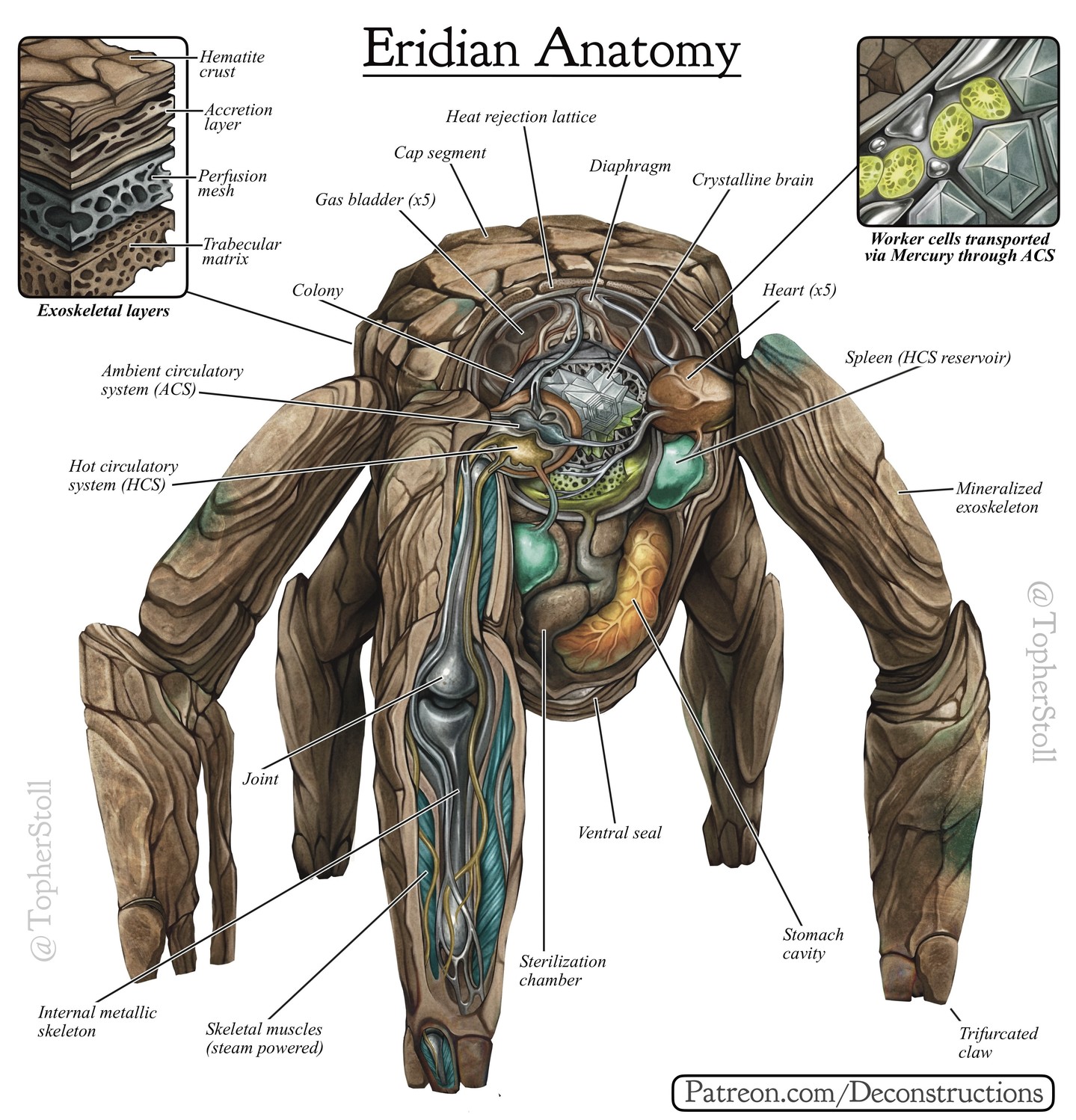
Imagine such an entity: product of an environment so corrosive, so hyperbaric, that xenon can be forged into metal. A powered faceless exoskeleton with mercury for blood and two independent circulatory systems, that perceives reality through sonar and magnetic fields. Radially symmetrical, so no sense of forward/backward, right or left. Egg-laying predatory hermaphrodite. Dual musculatures: one piezoelectric, one that runs off thermal gradients, both of which shut down entirely during dormancy. A crystalline optical computer for a brain. Blind to all EM; unaware even of the existence of light. These are but a few of an Eridian’s truly alien characteristics.
Now try to imagine the cognitive reality emerging from such an entity. Give me your best odds that such a mindset would converge on “friendly golden retriever”.
If I were to go the Hard-SF route— posit the scenario, interrogate the consequences— I’d wonder whether Rocky would even be sane by the time the Hail Mary coasted into orbit. One of the least alien aspects of Erid biology is the complete paralysis they undergo while asleep; they’re profoundly vulnerable to predators/enemies at such times, and can’t simply wake up at the first unexpected noise. So they are compelled to sleep communally, at least one Eridian always on watch while others are dormant. This would be baked into their very natures for as long as they’ve existed as a species: you do not, you cannot sleep alone. And yet Rocky is the sole survivor of a mission gone catastrophically pear-shaped; it could have been forced to sleep unguarded for months, years, before company arrived. What would that do to a being whose fundamental species hardwiring equates solitary sleeping with mortal danger? Rocky would be traumatized at the very least, suffering some kind of nervous breakdown. Rocky could be insane—downright psychotic—before the movie even started. That’s just one small ramification of Weir’s premise to get you started. Others are left as an exercise for the reader.
“Project Hail Mary” is not bad by any means. As I say, I enjoyed it. And if it was just being pitched as a light-hearted feel-good movie I’d just say, go with it. Mission accomplished. But that’s not how it’s being pimped. It’s being described as smart, rigorous, hard SF. Its rigor and empiricism gets thrust in our faces—“Built on Solid Science”, “science that either exists today or could exist given the right conditions”, “this story is packed with real science!”—like copies of The Watchtower from those pests that just won’t get the fuck off your doorstep. And sure, I’ll buy the equations are correct. I’ll buy that Weir calculated how many kilotonnes of astrophage was required to get to Tau Ceti, and how much time would dilate en route (even if the ship would have melted at those speeds).
But here’s the thing: while he showed his work, he didn’t follow where it led. We scribbled on the whiteboard; we witnessed the arduous process by which one makes painstaking first contact. We used Science to strip away the mystery, layer by layer, brought ourselves face-to-face with this profoundly alien intelligence, evolved under conditions we could scarcely imagine…
…Only to discover it wasn’t all that alien after all. It was like us in a crab suit. It’s so much like us we get each other’s jokes. It’s so much like us that Eridians have their own fucking elementary schools, where little Eridian younglings jump eagerly up and down with their hands raised, hoping the teacher will call on them…
Science is a powerful tool. It can help us parse the furthest reaches of the universe if we practice it properly. But this story—this paragon of Hard-SF, this bit of a genre that’s defined by looking unflinchingly at a scenario and asking what are the ramifications—has decided that the answer is People Are The Same All Over. “Project Hail Mary” instantiates the famous Lem quote: it claims to be about other worlds, but really it’s just another mirror. It has far more in common with the cozy Chambersesque Waltons-in-Space vibe than it does with Kubrick and Clarke, despite the hordes who keep polishing its Hard-SF credentials.
And I get it. I really do. We want reassurance, we want to think that no matter how alien and threatening something might seem, underneath our differences we can all be friends. I can understand the appeal, especially nowadays. But it rings hollow when we can’t even get along with our own species. It rings hollow when we’re presented with the setup of something so breath-takingly original, only to see it squandered on a Hollywood ending. And to have this held up as some kind of icon of Hard-SF…
…Well, “betrayed” is far too strong a word, especially for a fun movie with such a big heart. But all the people emphasizing the scientific rigor of “Project Hail Mary”, all those praising it as a work of “Hard SF”—I’d argue they’re cheapening the concept, at the very least. The movie’s carapace is Hard enough, to be sure. But look inside, and the really Hard questions go unexplored.
And this is coming from someone who’s publicly expressed misgivings about whether the very concept of Hard-SF has much functional utility in the first place.
Make of that what you will.
Yeah, I know about Clarke. But that story was about native solar life, not invasive. Also Clarke’s story had no solar-cooling shtick. ↑
“Defective”, in the Lasksa Media/European Astrobiology Institute coproduction Life Beyond Us. Also forthcoming in Fold Catastrophes. ↑








I avoided both the book and film in anticipation of many of the issues you raise. This post rings very similar to the one about the Asian androids film (also avoided). I would love to hear your thoughts on Dragon’s Egg by Robert L. Forward – another work lauded as being super scrupulously researched and plausible, but was possibly the most implausible book I’ve ever read. Instead of humans in a rubber suit, it was humans as flat caterpillars composed of neutronium living on a neutron star, on which time was accelerated by a million times because “nuclear reactions are faster than chemical ones”. I may be wrong, but I don’t think the speed at which things occur on earth are solely constrained by the speed of chemical reactions.
> I avoided both the book and film in anticipation of many of the issues you raise.
If you anticipate the worst in everything, how do you actually choose what to read?
I read a variety of reviews and summaries, both positive and negative. I refer to previous books by the author. I make a judgement. You?
That’s a fair way to approach it.
I read the book, and thought it was fun. The science wasn’t perfect, but when is it? Not every science fiction novel is going to be written by Mr. Watts or Mr. Egan!
The movie definitely dropped a lot of the science bits, but it was already nearly two and a half hours – something had to go, and I think they made the correct decisions for the most part.
If the worst you can anticipate is pretty good, then the real product is bound to be better, yes?
Forward wasn’t completely off in his conception of the cheela in Dragon’s Egg. The cheela weren’t made of neutronium, but degenerate atoms on the surface of a neutron star. In their interiors neutron stars are not pure neutrons, but about 10% protons and electrons, and on the surface normal atomic nuclei could exist. And the speed of biological organisms on Earth is largely determined by the speed of chemical reactions. Protons and neutrons are about 1/64000 the size of a hydrogen atom, so degenerate matter where the nucleons are nearly touching is also comparably smaller and reactions would be faster merely because of the greatly reduced size (electromagnetic interactions could be 64,000 times faster).
Yes, the cheela are unimaginatively very much like humans in their personality and culture, though.
Yeah, as I recall the Cheela even had a Jesus figure…
My wife took me to see it purely so she could be entertained by me dissecting it and generally ranting like a maniac for the rest of the evening. Glad to see I am in good company.
I’m reminded of Niven’s Known Space stories, which were ram-full of acknowledged violations of all kinds of “fundamental physical law,” which just nodded in acknowledgement of that and posited a special black box for getting around the issue. Not just the FTL hyperdrive, but also the reactionless “thrusters” for navigation inside of star systems, and the artificial gravity that is so cheap it’s built into people’s beds on Earth, and so good it can keep people from getting squashed by 50g acceleration by those “thrusters.” And don’t even get me started on General Products hulls.
Anyway, my point is, there can be a shitload of magical tech in a SF setting and it can be considered legit “Hard SF.” There just has to be some kind of handwaving in acknowledgement that fundamentally new physics was required to get it.
Also the infamous “the Ringworld is unstable!” (a uniform density ring won’t stay centered on its primary under gravity and if it gets off center it will accelerate further off center). Hence the introduction of ring stabilization thrusters in “The Ringworld Engineeers”.
If you run the numbers on tidal forces in the story “Neutron Star” you’d find that poor Beowulf Shaffer would have been torn apart even in his spread-eagle flat position at the center of mass of his ship. Also I’m told that after a close encounter with the neutron star the ship would pick up a lot of angular momentum and come out spinning extremely rapidly, which also would have been bad for Shaffer if he somehow survived the tidal forces at closest approach.
Niven’s a good example here, for different reasons than you suggest. His aliens were alien;hell, his humans were alien, literally. And while the idea that we’re descended from aliens from the galactic core is clearly wrong, Niven took that premise and asked “What are the consequences?”. The question is not whether the premise is accurate; the question is, given the premise, what are the logical ramifications? Niven did that (even with premises that were batshit). Weir, I’d argue, did not.
I think that Niven is also a good example of hard SF, or at least harder SF, because he thinks through the implications of the technology in his settings. For example, in The Mote in God’s Eye (cowritten with Jerry Pournelle), the Langston Field was created so that the spaceships wouldn’t be eggshells armed with hammers, and you can have dramatic space battles. But the authors thought of how you would need to work around it to take measurements and readings, how it could be used as a ship radiator, and how it could also be used as a containment chamber for a fusion reaction. The Moties create an improved version that expands as it absorbs energy, but because the exit for their Alderson Drive is in a star, that means that it lasts much shorter than a standard Langston Field. A lot of authors would have said, “I have an energy field that shields my ship, and that’s it.”
On a side note, I have only read the book version of PHM so far, but the Eridian biology was my favorite part. They are probably the most imaginatively designed aliens I have read in a couple of decades. I didn’t really think about how it might be the logical endpoint for a complex anaerobic lifeform, so thank you for that!
The book actually solves a lot of these problems. Something about a medium where you can make a braindump of MC trying to figure out how things work.
The ‘alien’ is still filled with “indomitable human spirit” archetype of a frontier hero, but there is generally a lot more space for the ‘hard’ part.
C’mon, the genre is starved, personally having no magic shields and gravity classifies as hardish scifi in my books
Low bar, dude. Low bar.
But again; I did like this movie! Honest! Just not as hard (even hardish SF!)
I mean, yeah, kinda. But then again, it is not as if the genre of Hard SF (whatever exactly that means) is thriving. At least not here in germany, it is essentially dead, at least judging by what bookstores have on offer.
I mean, it is certainly “hard” SF compared to most SF that might as well be fantasy (which i dont inherently dislike or anything)
Honestly, the most fantastical part about the movie is probably the fact that earth even gets its shit together to start that expedition, and science is even accepted on the most cursory level.
I have a much harder time believing in that, than in magical astrophages.
Yeah, I WAS struck the whole time reading the book by the idea that humanity would be facing a collapse of all complex industrial society and mass extinction, and would decide to take immediate and decisive action with (at least during the timeframe we see) unlimited international cooperation.
Like… that’s already the situation we’re facing.
I guess when the problem is external, and not the thing underpinning industrial society, and those in power have no way to get rich off of it, then maybe.
Your main complaint – that the Iridians are just “like us in a crab” suit reminds me so much of the tines and “spiders” from the to this day much-hyped (at lest on Reddit) novels by Vernor Vinge, A Deepness In the Sky and A Fire Upon the Deep, where despite massive fundamental biological differences, Vinge’s aliens are, well, so exactly like us that they even recapitulate the entirety of human history, specific world wars and all.
Martin Dudley, above, correctly mentions Dragon’s Egg, which does the same thing, too. The schtick was clever back in the 1930s, when (I think it was) Murray Leinster’s narrator and alien buddy ended the story “First Contact” by swapping dirty jokes, but Jesus god, and I tired of it now.
I gotta defend Vinge here. The Spiders in “A Deepness in the Sky” are not that similar to humans: they are *portrayed* that way by the translators who study their culture, because the lead translator is obsessed with Earth culture and discovers that the only way of making the spiders inteligible to us is to present them as humans. This is to say: the “guy in a rubber suit” is explicitly built into the premise of the story as an intra-diegetic problem. Wether this is convincing, depends on the reader, but I quite like it. “A fire…” I don’t like so much, though it has some cool ideas, too.
I can see how you might accept the conceit, but it didn’t work for me; it just seemed like a cop-out on Vinge’s part. Either way, he didn’t create alien aliens, if you take my point.
Yeah, point taken. But it’s so hard to find actual alien-aliens, that even the conceit of “there’s aliens behind this curtain, guys, I swear” is something already!
Hey, you want Alien aliens? Shroud (same conceit as Vinge’s tines, but worked to much better effect). Solaris. Blindsight. 2001 (although that might be a case of your behind the curtain thingy). Exordia.
Just off the top of my furry head.
After you hyped Tchaikovsky in that posh interview, I read his Shroud, and the first three “Children of…” things (I’ll get to Strife some time this year). And gotta say, he’s very inventive in this “alien mind” area. Shroud seems to really take the cake in this department. But Portiids were fun as well, and octopodes deserve some kind of weird-ass seven dimensional color-rotated cake too.
That was a great recommend. I’m putting Exordia on my list as well.
Give Exordia’s aliens a while. The first one seems almost Monty-Pythonesquely adorable and human at the outset. But you’ll be seriously creeped out by the time the war crimes show up. And the fractal eyeballs.
Exordia has to be one of most unique and wild fiction stories I’ve read recently. It’s take on objective “free will” is pretty interesting too.
It does seem to go into fantasy every once in a while, but the sci-fi aspects were very creative and smartly done IMO.
I frickin loved Exordia. Shame that we will probably wait for a sequel even longer than for Omniscience.
Well, of course ‘Solaris’ and ‘2001’. And I’ll take the chance to recommend another one by Lem, which I find even better than ‘Solaris’ and has some pretty alien-aliens, too: ‘Fiasco’. You’d really enjoy ‘Fiasco’, I’m sure. That second one you mentioned — ‘Blindsight’, is it? — I haven’t heard of, but it sounds awful, like it was written by some mad marine biologist. Mad, I say, but incredibly handsome, if I had to guess.
“Fiasco” was the only first-contact novel I’ve read in which the aliens turn out to be loaves of bread.
It took me years to figure it out.
I give you the spiders, albeit with a conceit that was already mentioned, but I wouldn’t call Tines “exactly like us.” They were similar enough that Vinge could tell a story with them as main characters (it’s hard to create a truly alien mindset and make it compelling to readers… rare and valuable enough that even attempts that aren’t quite as ambitious deserve praise, IMHO), but the way their minds worked and were different came up again and again. On a gross level they were ‘like people’ but they still differed in tons of little details, and details matter. AND they weren’t even the only alien main characters we got (The Skroderiders were also ‘just like us’ in most ways but I still loved the whole ‘our ability to translate short-term memories into long term is kind of shit and has to be mechanically augmented for stuff that isn’t happening repeatedly, by technology granted to us from a long-vanshed race’ aspect)
Had a bad feeling about it when I started hearing the “Oh-Em-Gee it’s hope-core” comments start making the rounds, so I’m relieved you bit the bullet for us, Dr. Watts.
David Brin (I think he still qualifies as modern?), though you could make the same complaints as you do of Clarke
Sundiver, right. Forgot about that one. I have amended the post appropriately.
I am still almost irrationally vexed by Brin’s Uplift series after reading most of it thirty-ish years ago. In a series where he acknowledges that, compared to any alien, a black widow spider is a human’s close cousin, he still not only makes the aliens comprehensible, but very much an extended Planet of Hats (each alien species is characterized by one trait). Grrr.
Planet of Hats. I love that phrase.
I liked the novel and the movie both, and ultimately I agree that the story simply isn’t hard sci-fi — it’s simply more of a medium-soft sci-fi which is challenging to people who simply haven’t encountered harder science fiction than Star Wars.
In this regard I got asked by a friend about how I’d compare it all to your body of work and I said, truthfully, there’s no comparison — what you do as an author and what he does as an author are simply entirely different genus.
As I wrote on FB; Defining Hard SF has the same problem as defining SF; I know it when I see it.
But, nailing the definition down is on par with understanding the collapse of the wave function as a change of what you know, rather than anything substantial in the real world.
Also, by Hollywood standards, what they consider accessible to their market, PHM is hard SF.
I’ve read the book, but not seen the movie.
There was a time when Hollywood considered “2001” and “The Andromeda Strain” to be hard science fiction.
I miss those days.
I think you’re a bit too hard on it. Both the movie and the book.
Absolutely, everything you say are fair points. But the fact that these can even be raised for this movie seems to be enough to put it into the hard SF slot.
Yep, blueshift ablation. Yep, golden retriever rubbersuit mechacrab. Yep, dumbed down hollywood ending.
But look at the list of sci-fi of 2020’s: https://en.wikipedia.org/wiki/List_of_science_fiction_films_of_the_2020s
There’s the MCU slop, the Justice League slop, the fucking Bloodshot and Infinite.
It’s just there isn’t a bucket to put the sci-fi that actually tries to pay respect to the science into. However clumsy, stumbling and naive it sometimes is, it actually fucking tries to give a nod to the “sci” in the “sci-fi”.
There’s work that puts more effort into that nod than PHM. But I’m not sure it makes sense to dismiss the effort altogether.
Maybe it’s the “hard” that is the misnomer. But there’s gotta be some way to separate Dune or All You Need Is Kill from PHM.
And after that’s done it would make sense to sift through PHMs shortcomings and declare it mediocre on the hard sf scale.
Otherwise Gosling could shoot blueshift ablation out of his ass with space magic for 90 minutes straight and no one would bat an eye.
Alternatively, imagine someone trying to shove Avatar into the hard sf bucket. There aren’t even any specific things you could point and say “this ain’t hard enough”. The whole thing’s just a fairy tale.
Disclaimer: I’m not trying to shit on the space fantasy or space opera or techo-action subgenres of sci-fi (or whatever the fuck these branches are called). I’m trying to defend genre classification for PHM as “hard sf”.
You don’t have to imagine someone shoving Avatar into the hard SF bucket, because it is as hard as PHM.
The spaceship radiators and travel time. Eywa is a networked hive mind.
See this blog for why one should view Avatar as an iteration of the dark forest (https://sf-apologetics.blogspot.com/2018/12/avatars-dark-forest-part-1.html)
The guy discusses “Alpha Centaury” (sic) and just dumps the whole space apes thing onto the shoulders of convergent evolution. “Networked hive mind”. Yeah, sure, whatever, buddy. The Sleeping Beauty is an early depiction of hibernation pods. The Gingerbread Man is a story of a rogue android.
I mean, it was not your intention, but it IS funny to me that you sound exactly like that evil executive in Avatar 1 when the hivemind got brought up.
Look, like i said, i have plenty of problems with Avatar, not least the whole “White Saviour” trope that it fully leans into, but eh, the human tech seems pretty believable to me on the whole. And the whole “hivemind” thing? Well, obviously that is a stretch, but at least the individuals are not communicating over a whole globe without any apparent hardware like in “Pluribus”. I can dig it, doesnt seem more fantastical to me than plenty of things that happens in “bona-fide” Hard Sci-Fi.
Now this is solely my personal head-canon, but i always thought that the ancestors of the Navi had some kind of hightech civilization and then just gengineered that all away to “return to nature”, including their mother-goddess and all that conveniently compatible cabling in their and their animals heads. Would explain the ruins we saw in Avatar 1, at least.
I’m rooting for the Navi being the earlier settlers of A. Centauri. Successfully settling the universe? Of course you adapt yourself to the local environment, duh; attempting the opposite is narcissistic folly.
Neatly explains the 4 vs 6 limbs thing. Also means their spaceships (mothballed) when they rise will be boss.
Will Cameron do this? Effed if I know. Avatar 2 was a corpulent sack of self-indulgent fanboyism. 3 hours of never-mind-the-shite-storyline-enjoy-the-pretty-scenery slog, half an hour of, you know, actual action happening. The Terminator it is not.
Everyone knows you never go Full Lucas.
It seems pretty clear to me that Cameron long checked out of trying to tell a meaningful story (which is why, Tech underpinnings being realistic or not, Avatar is indeed not really Hard SciFi imo).
He just doesnt care any more. He just wants to show us all Pandora and create the most gorgeously animated planet EVER. That is it.
And i am honestly fine with that. I never went into the Avatar movies with a bigger expectation than that, at least not after Avatar 1. The story is just an excuse for him to show us MORE Pandora.
You don’t have to imagine someone shoving Avatar into the hard SF bucket, because it is as hard as PHM.
For example; the spaceship radiators and travel time. Eywa is a networked hive mind.
See this blog for why one should view Avatar as an iteration of the dark forest (https://sf-apologetics.blogspot.com/2018/12/avatars-dark-forest-part-1.html)
TBF, that was the best spaceship porn, ever. Trounces even Kubrick’s Discovery. Honestly, as a kid who grew up imagining travelling to other stars I could watch 3½ hours of the Venture Star washing its hair and leave this universe happy.
Huh. As much as i have my gripes with Avatar, the sciency-aspect of it seems pretty solid to me? No FTL, realistic spaceships with radiators, machines that could definitely work, a whole lot of super-advanced biotech but nothing seems outright “impossible”, at least not to a degree more unrealistic than, say, Solaris?
I’m on roughly the same page. The simpleminded moralizing and white-savior shit made me puke. The Human tech was well-thought-out. I was willing to forgive the humanoid Navii because it wasn’t lack of imagination on Cameron’s part: he’s explicitly stated that “the aliens need to have tits” because otherwise audiences won’t relate to them, and at least he gave us brief glimpses of indigenous intermediate forms between the Navii and the other multi-eyed multiarmed biota, to suggest how the titular aliens could have evolved from that stock.
What I couldn’t buy was that every human biologist was apparently too stupid to notice that the entire Pandoran ecosystem had clearly been deliberately engineered. I was also miffed that all the predator-prey relationships seemed way too earthlike on a world where every animal came with a USB port hanging out of its head. Not a single observed case of predators attacking prey by hacking into their ports and hijacking their nervous systems. No instances of prey defending themselves by doing the same thing, only backwards. No small bulbous parasites feeding off the ends of the data cables. All that body-snatcher potential, and nothing ever got past teeth and claws.
Come on, Cameron. I saw T2. I know you can do better.
Oh shit. Now I’m jonesing for Peter Watts’ Avatar: A Movie. Vicious magnificence.
(Currently reading Bill Burroughs’ Blade Runner: A Movie, so it can be done.)
Anyway, boss, don’t you have a Star Trek episode to be writing? You know, about how humans go into the universe and everyone they encounter looks exactly like themselves?
(Yes, I know: Rorschach OPSEC. Clever bloody basterd, that Dr Watts. Possibly non-terrestrial. Approach with caution.)
He could do better. Easily. I genuinely think though, he just doesnt WANT to, anymore. He has made a lot of groundbreaking movies and told great stories, but now he wants to just faff around Pandora and give us ever more gorgeous vistas of an alien planet in his old age.
The story is not the point, it is just an excuse to blow another bazillion dollars on the most beautiful rendered world ever.
As for the ecoystem: Eh. IF it all was engineered to perfection (which i think too, it would explain so much), my guess is, the engineers made sure no nasty bodyjacker parasites had a place in that system.
Complete headcanon: The Na`vi are the descendants of a hightech civilization hat decided long ago to go “back to nature” and gengineered the entire world to turn it into some theme-park version of a real ecosystem where they could play at being noble savages. Well, if i were to do that, i would make sure not to include nasty body jacker parasites and the like, that is not as cool and romantic as huge armored predators after all.
That is really good head canon.
Stephen Baxter’s Xeelee sequence has ‘Photino Birds’, creatures made of dark matter, that deposit their larvae in stars, sapping their brightness. It turns out that nothing can be done about them. Worth a footnote, anyway.
Oooh. I had not heard of that one!
“Dragon’s Egg” has life on the surface of a star — a neutron star, no less. It was a fun one, as I remember it.
It was fun, even though in terms of prose style Forward couldn’t write his way out of a fortune cookie. Also it was curiously unimaginative when it came to basic tech (computer technology circa 2050 was portrayed as glorified teletypes that PRINTED OUT BASIC TEXT IN ALL CAPS, forex). And while the Cheele were extremely cool in terms of anatomy and physiology, behaviourally―as others have pointed out in this thread―they were basically humans in degenerate-matter costumes.
Who’d have thought the author of Blindsight and the Rifters trilogy could be such a big old softie at heart?
Well, me, of course. I thought that. But it’s sweet to see how you keep getting your hopes up, just so they can be disappointed.
The novel isn’t better because Andy Weir is incompetent. You would imagine that being totally unable to write a believable human would make him better at writing aliens, yet by this description the film’s Rocky is just like the character he wrote. I forget if he made excuses like the ones you were looking for. His writing no more sticks to the ribs than that of a Harry Potter novel, and the book was barely worth a first read, much less a second.
“Hard science fiction” means nothing except to science fiction writers and their audience, which is execrable. Ever notice how much work Heinlein put into avoiding his fans? He had good cause to do so, about as good as yours, I think. “The ‘Golden Age of Science Fiction’ is twelve,” and all that. Few in my experience ever outgrow it. Thank God I did.
In this whole discourse one specific point seems to be missing: there’s no good hard science fiction for younger audiences especially young women. All they have is just capeshit and space fantasy. The only recent big title was Revenger by Alastair Reynolds. Maybe the hope police did not understand their own assignment either, it shouldn’t be about making stuff optimistic it should be about making it kid friendlier.
I’m not very up on YA titles, but you’re probably not wrong. Definitely not on the gender gap which has been the case since at least Hypatia.
I grew up on Nicholas Fisk. Flamers, Time Trap, Grinny. A Rag, a Bone, and a Hank of Hair. Old but good. Maybe not hard hard-SF, but solid.
Of recent reading, Micaiah Johnson’s The Space Between Worlds is definitely worth a squint.
Science should be the absolutely kid-friendliest thing ever. It takes a really concerted effort to teach our young to hate learning; and yet here we are.
Social conservatism has lots to answer for.
I’m curious if Mr Watts has seen Upstream Color (2013)? Apropos of nothing.
I have. I liked it. Like its predecessor, I think it demands repeat viewings. Unlike the case with its predecessor, I so far haven’t got around to doing that. But I really should.
Please don’t take it personally but I think Rocky is a much more interesting example of an alien than Scramblers. Andy Weir put a lot of effort into explaining Eridians’ psychology, and the fact that they are so similar to humans.
In fact, why would they be dramatically different? Both Eridians and humans live in the same Universe with the same laws of physics, on the surface of similar planets in the similar star systems. In the book, Weir discusses a hypothesis that the speed of cognitive processes depends on gravity. Imo, this is a very plausible assumption – our cognition is largely defined by the physical world we live in.
I also love weird, unusual depictions of aliens in Sci-Fi but, let’s be honest, most authors just end up describing “scary space monsters” without any details or motivation whatsoever. And, of course, these aliens should be malevolent because there is no such thing as cooperation in our world. Weir is a fantastic storyteller, and I loved how he played with this stereotype, only to break it later.
I totally get how you found Rocky more interesting than my scramblers. We evolved to relate to things that are like us. Rocky is definitely like us, where it counts. Your reaction is perfectly natural.
That’s not to say that it’s realistic, though.
Again, I haven’t read the novel. Still, given that I have a few degrees in biology and Weir has none, I think I’m justified in being a bit skeptical when you tell me that he “put a lot of effort into explaining Eridians’ psychology, and the fact that they are so similar to humans”, especially if the rationale is that “live in the same Universe with the same laws of physics, on the surface of similar planets in the similar star systems”.
Consider the octopus. Half his neurons are in the arms; each arm seems to possess its own brain, with its own motives. The hoop of neurons around the esophagus might be little more than a sensory integrator and a router to coordinate the other sub-brains. You could argue that there’s no such thing as an octopus, singular; you could argue that every individual is in fact a colony of selves. In terms of cognitive architecture, that’s pretty fucking alien. It’s far more alien than Rocky is, cognition-wise.
And octopuses evolved on the same planet that we did. Compared to Rocky, octopuses and humans are kissing cousins. We shared a common evolutionary history until a billion years ago.
Given that kind of divergence just here on Earth, the idea that life evolving in a hyperbaric anaerobic environment dense enough to metalicize Xenon would be more similar to us psychologically than octopuses are strikes me as, shall we say, doubtful.
Scramblers had problem solving, off-band communication and situational awareness. Plus they somehow overloaded my synapses while reading, it felt eerie. Like intentional blurriness on their side, not the author’s side.
How the hell did he do that… anyway. Peter, what if consciousness is fundamental and distributed in discrete chunks throughout the universe.
How fluffy would that science be to you?
Given that physics as we understand it has absolutely no way of explaining how consciousness might emerge, I’m not ready to take anything off the table. Physical panpsychism may seem batshit, but it’s no more batshit than consciousness itself. I’m not even looking down my nose at Kastrup’s Idealism. Both those alternatives may kinda get around the question by just relabelling it as a “fundamental property of matter (or in Kastrup’s case, matter as a manifestation of consciousness), but I don’t see anyone complaining when physicists talk about the “spin” of an electron or the “flavor” of a quark.
I pass judgment on many things. When it comes to consciousness, though, I think I’m just gonna watch and (maybe) learn.
Spitballing here (aka pulling from the nethers), but I think key is to recognize that “Self” isn’t even real. It’s just an emulation of what a “Human 1.0” is [believed to be], executing atop elderly wetware.
How did we get to this fib? Roll back the clock a few hundred millennia. Take established, successful predator and prey models, trained on savannah to discriminate Foe (lion) from Food (gazelle). Now throw Friend (fellow hominid) into the mix. More specifically, “Friend[?”]
Foe and Food are straightforward, with a billion years’ proof: both are reliably stuck in their roles. Safely predictable.
“Friend,” though, beomes tricky. Fellow hominid looks like us, moves like us, grunts like us. Hunts with us, great; everyone eats. Sometimes hunts us (game theory), not good. Complicated behavior. Confounding signals. A three-body problem for the age.
Evolve an additional explanatory model to explain this; that’s a powerful survival advantage. Now you have a rudimentary Theory of Mind. A complex, dynamic, emulation of fellow hominids’ uncommonly dynamic behaviors. Throughout ongoing real-world testing and use, observations accrue that different approaches to “Friend[?]” may modify their behavior.
How to turn this to survival benefit? Loopback that working ToM so now it not only models them, it models us too. Now we can pre-tailor our own behavior to optimize theirs, and a Generative Adversarial Network is cooking. All running on time- and energy-intensive high-level CPU, having long outstripped the rigid capabilities of older, simpler “instinctive” wiring. And yet, in daily use this hungry machine proves that it’s worth the investment.
How complex and sophisticated do these self-reinforcing unwittingly-collaborative feedback-loop-powered models need to grow before “Self” offshoots as incidental by-product of constant interactions between hominid units? Maybe Carl Yung’s “collective unconscious” wasn’t complete slop. Introspection had to start somewhere, ironically born in the collective.
.
All falling apart now, sadly, as vampires (and I don’t mean the nice Wattsian kind) increasingly corrupt this network, reprogramming all its finely honed high-level protocols right back to the basics: just Foe and Food. Poor old savannah-trained wetware cannot keep up, can barely detect it; its IFF spoofed. But that’s a monomanic diatribe for another day, I think.
Yeah, but everything you’ve described is a calculation: predictions of behavior, predictions of predictions, responses to stimuli. You haven’t explained why all those computations must necessarily be conscious.
“Spin” and “flavor” are just english terms for exact mathematical descriptions. And the math matches experimental measurements to better than 1 part in a billion. That’s why people don’t complain to physicists about terminology. It’s actually pretty fucking good at describing the world around us.
>But it rings hollow when we can’t even get along with our own species.
Well, they do say familiarity brings contempt.Maybe the appeal of critters not like us is exactly just that?
Regarding life on or inside stars, there’s relatively modern German novel about it, *Der Schnitt durch die Sonne* by Dietmar Dath (who is a fan of your work btw). There it goes more with the classic Stanislaw Lem notion of self replicating magnetohydrodynamic structures in plasma evolving to sentience. The book is a bit funny in how most of it takes place *on the sun* but basically viewed through a VR filter lens by humans whose minds were uploaded into the sun so actually almost everything seems ridiculously human like… but there’s this constant sense of “none of this is actually real, this is them being dissected” hanging over it.
This movie worked on me more intuitively than rationally, through symbols and myth. Note the telling name of the protagonist ‘Grace’ and the title ‘Hail Mary.’ This is a story of a Call to Adventure of the Reluctant Hero and how sometimes that call is unanswered; The Refusal of the Call (keystone cops impressment scene). I will laugh at your calamity. Upon awakening Grace faces the Road of Trials and then the boon is bestowed. You can also see Grace as the Messiah who saves humanity by literally bringing light back to the world, breathing life back into the sun. Sol Invictus. Like the Savior he is a lone bachelor. He sends the holy canisters with the good news to Earth and then disappears into an alien womb.
Yeah, when you put it in that context it totally works.
A criminally underappreciated comment. I lol’ed so hard I woke my cat. Completely lost it at Sol Invictus.
It’s quite precise, of course, which is what makes it hilarious.
I guess, that makes Rocky the Magical Helper or The Goddess. Or, Pontius Pilate, if that’s your chosen frame.
To me, the psychology of the alien is the best part of engineering aliens in hard sci-fi. I believe the dramatic tension would’ve been much better in the movie if Rocky was introduced as “insane” in the beginning and Gosling’s character would’ve been stuck trying to care for an insane alien while simultaneously trying to figure out what’s going on. It also would’ve made their bond much stronger for later, more dramatic sequences, like when Rocky jumps out of his shell to save Gosling while they’re falling from orbit. Creating alien psychologies can actually make a story more dramatic, but unfortunately Hollywood likes to play it safe and ends up making the aliens into humans or puppies. With your vampires I loved them specifically because they are the opposite of this trope (them, and the Scramblers) and I took some time to make an infographic on how they reproduce as a subspecies of humanity. I know in an earlier blog post you said that you can use just-so stories to justify anything you want about the vampires—so I tried to keep it as general as possible (except for the last panel—that one I extrapolated a bit too much on but kept it because it was too weird and interesting). I would also like to note that I generated this with AI so it took some liberties with the design.
Karen, this is…amazing. I mean, my own head canon was that reproductively, vampires were essentially coldblooded cuckoos that parasitised human social networks―but I never wrote that down anywhere and this is a really cool bit of extrapolation (also beautifully rendered just on artistic/technical grounds).
The Gallery wing hasn’t been updated for well over a year now (other things keep getting in the way), but with your permission this is definitely going into the gallery when I bring it up to date. Just beautiful. Thank you.
This is truly the best response I could’ve ever hoped for. Thank you so much!
To be honest, I thought the cuckoo explanation is what you would actually go for. But I am so excited that you like mine! Yes! Absolutely! You can totally use my infographic!
Also, I am half-way through Echoparxia and I couldn’t help but look up spoilers. There seems to be rumors going around that it’s revealed in the book that vampire territoriality might’ve been amped up by their human enslavers. In which case, I made this second infographic about what that could mean.
BTW, you can still keep some of the horror elements even with all of this because vampires can still have human slaves for various purposes. Cooperative breeding did not stop us from enslaving black people and using them as wet nurses, for instance.
Anyway, let me know what you think! And if you want to make some changes to these infographics yourself through ChatGPT go ahead! But I have already ran these through multiple times so it might mess with the final outcome.
Anyways, thank you again! I am so glad I could add to your impressive universe!
This reminds me, I have soo many unanswered questions about your vampires. A lot of them stem from the fact that they are evolutionarily closely-related to us and they seem to be a social species (nurturing their young for a long time I assume, pair-bonding?), so there’s a lot of cognitive attributes I would perhaps expect them to also evolve that I didn’t quite get to see in the books. I am just going to rant here for a bit:
I think the issue is that you have to walk the tightrope between making them make sense (for the sake of the plot) and not making them TOO human. Also, this stuff needs to be relevant to a hard-sci fi horror story anyways. Having the vampires cry at funerals or crack jokes at each other would ruin the experience. And going into a giant backstory about them can just turn into a long, boring diatribe. Some things should probably just remain a mystery.
Fun fact though, other predators in the wild like leopards have been shown to use psychoactive drugs that can have various positive effects on them. So maybe vampires do it too? Who knows.
I can’t say if I agree about the exposition logic. I think more clarification can make for more interesting storytelling while still retaining the horror elements, and even enhancing them if done right.
So for example, I am not sure if a vampire would as easily cry (like at funerals) as a human since they can probably grapple with the future and stuff better than us. But they may cry at something that requires more intellect for humans to even comprehend the grief factor of it (sort of like explaining melancholy to a bee?). Similarly, their sense of humor could be based at a “higher” intellectual level than the comprehension of humans. I think stuff like that is hard to write in storytelling but if done right it could be very compelling.
Also, given the hard sci-fi nature of the novels, a great part of the enjoyment for me is being curious. So asking these questions about the vampires is fun because it is related to how evolution of cognition / behavior works in real-life.
Pretty certain Wattsian vampires are 100% psychopaths, so you can scratch much of that. They don’t need it. It’s all baggage. Their Theory of Mind runs super-fast and lean. While H. sapiens is humming and hawwing over whether something moving in the grass could be Food or Threat, the vampire has already modeled both outcomes simultaneously and is executing optimal strategy for encounter, closing the gap between “Oh, hi, frie…” and its dinner.
.
As for how H sapien vampiris do behave, pick a successful apex predator from [what’s left of] Earth’s megafauna and model from that [1]. And don’t overthink it.
Honestly, your own human theory of mind becomes a huge liability here. Our kind automatically, implicitly, unconsciously projects our personal Self into every human-shaped object we see, working to explain its thoughts and behavior in terms of “What would I do here?”
Which works terrifically well when it is another human a lot like ourselves; very effective predictive model, if awfully dependent on shortcuts. But when it turns out your IFF’s spoofed? When the other’s observed behavior suddenly confounds your projections? When you see teeth?
You know your model works fabulously well—you’ve been testing and refining it in daily real-world use all your life. So you dismiss this one-time contradictory observation as obviously “transient error”; even as vampire gnaws your bloody leg off, you’re driven to select what you know is reassuringly right over what you’re now experiencing. Disbelief your last conscious choice; one less vaunted sapience bogging the whole eco system.
Like Le Corbusier tripping balls on Antoni Gaudí. Viciously minimalist curving everywhere.
—
[1] Mind that the resurrected vampires of Sarasti’s time have had their social wiring deliberately corrupted so mere sight of another of their species drives them into kill frenzy. But if Valerie could hack around the crucifix glitch no problem I doubt enforced celibacy will endure terribly long either. Still, might be delicate.
I modeled Watt’s vampires in my infographic off of various species.
The territoriality comes from big cats (specifically things like Tigers, Leopards and Jaguars, but not Lions). My diapause framework was based upon the 130 mammalian species that can pause pregnancy (the infographic says they can pause their growth in early childhood too—which can make sense due to the undead phase). The monogamy is based upon the idea that in nature animals that have 1. Scarce prey 2. Low population numbers 3. Large territories & 4) Long dependent offspring are monogamous (i.e coyotes—a highly adaptive predator—who are famous for their 100% fidelity rates). And finally, the long migration routes are based upon animals like White Storks who can travel thousands of miles to mate.
That said, I am a fan of the idea that vampires have their own, unique, psychological traits such as a special set of “vampire emotions” that helps them navigate the world in their own, unique, vampires ways that humans can really quite get. Same thing with special vampire humor or rituals. I remember a while ago reading speculation about how current LLM’s can have emotions due to emotions being just preprogrammed responses to the environment. Considering that vampires filled a specific environmental niche in. nature I can imagine that this is the case as well. It’ll be interesting to see if any of this is touched in Omniscience. But you never know.
Sarasti possessed an excellent sense of humor, this was clear from the novel. That the pleasure he derives at pulling your leg is quite indistinguishable from his pleasure at slitting your throat (at least from us baseline humans’ dull perception) is part of the character’s charm. Keeps you guessing.
Speculation as to the degree our gracious host projects himself into his [ostensible] monster, I’ll leave to others. Although seeing as it’s us H. sapiens who killed his beloved ocean, I certainly won’t begrudge him leaning hard.
I like these Wattsian vampires. Much more human than a significant percentage of our species; and scrupulously honest too, which beats us all.
That’s all super interesting. I always felt bad for the vampires being forced to become territorial.
I do have some trouble understanding how a species that is psychopathic as a whole can evolve, considering that when we look at mammalian predatory species in nature (coyotes, wolves, raccoons, bears, cats), regardless of their “intelligence”, their emotions are complex. Basically, it seems like having a species where all or most individuals are psychopathic is less preferable than having a social species that’s a good predator.
My limited understanding is that at evolutionary timescales, prosocial behaviors (which are regulated by prosocial emotions) are actually advantageous. And regardless of how brutally predatory or smart a species is, it seems possible that it can have complex positive emotions for “friends” while being cold towards “foes”. I am thinking that “smart” species require raising young ones for a longer time (which would require something akin to love to exist genetically I assume? So they would find things cute as an extension of that?). And then life-long pair bonding if that’s confirmed would also require certain prosocial emotions. Then just generally from nature and I believe (game theory too?) that working in a group is advantageous (kin selection and reciprocal altruism). All of these lead to all kind of interesting emotions that we observe in apes (humans particularly).
So my head canon is that vampires are more interesting and complex like most predators than just plain psychopaths, and hopefully they have muuch more complex versions of emotions than humans (like I would imagine a less smart ape won’t experience something like anemoia, but we can).
I based a lot of speculation about Watt’s vampires around the idea that psychopaths CAN have monogamous relationships and even morals. The neuroscientist James Fallon is the first person I think about when I think about a “pro-social” psychopath. That said, there is some debate as to whether Fallon actually is a psychopath and he was raised by neurotypical people. So, it’s probably safe to say that in order to have any social structures wild vampires have to have SOME type of “pro-social” emotions. Unless we go back to the idea of some form of brood parasitism. Of course, thanks to Echopraxia the idea that the humans did some mental tinkering on the vampires with these things is not TOO far off.
Oh I remember reading about Fallon, pretty cool case.
I also refreshed my memory of Watts’ vampire neuroscience and the most significant thing in terms of sociality seems like the anterior cingulate is not well connected to the rest of the brain, which results in the lower empathy. I’m not sure this is normal for psychopaths either – they have lower activity but I am not so sure about the almost complete disconnection from the neocortex.
Also unlike psychopaths, they seem to have normal vmPFCs (Maybe? Can’t find any info on this) and enlarged amygdalae. So presumably no trouble decision-making and over-powered at pattern-matching and a bunch of other stuff like social cues.
The anterior cingulate stuff makes me wonder if they can have a lot of pro-social emotions at all and even feel things like pleasure. But such an extreme “anti-social” personality makes me question how they could evolve successfully in the first place as I mentioned before. Maybe the anterior cingulate was isolated by human tinkering. I am out of my depth here.
Some super-interesting extrapolation here, and I don’t want to cramp anyone’s style. A few points, though: vampires are definitely solitary by nature, so the kind of complex social interactions you get in wolves and orcas doesn’t apply. Also, wolves and orcas don’t eat prey that looks pretty much like they do; vampires are unique in preying on something that’s so much like them it’s virtually conspecific, so there’s strong selective pressure against empathy that I don’t think you’d find with other predatory species.
The only thing that the vampire slideshow said was “neurological isolation of the ACG” as a bullet point. Which is vague and can be interpreted differently as you can isolate parts of the ACG in surgical settings and actually have improvements in patients suffering from things like OCD. Perhaps the vampires have a special form of ACG “isolation” that is not detailed well in the powerpoint. I’ll post a link to a paper on this as reference if you want to read it.
https://www.ncbi.nlm.nih.gov/books/NBK537077/
Thanks. I still don’t know what to make of it all.
I actually found a PDF that mentions the amygdala and some other brain features briefly.
“Synaptic interconnections between the anterior cingulate gyrus and the rest of the brain were much lower than normal, almost as if the core of the brain were being isolated from the neocortex.”
https://www.rifters.com/real/shorts/VampireDomestication.pdf
I am sitting on the toilet gearing up for some weightlifting at the moment, so I have nowhere near enough time to answer all those questions. But according to my own head canon, many of them don’t even apply. It’s stated explicitly in Blindsight that at least some taxonomists don’t even regard vampires as a separate species because they’re not reproductively separate from Humans. My thinking was that early vampires didn’t have much in the way of their own society; a male would impregnate human female and then bugger off, leaving the mother to wonder why their child was such a cold and unfeeling monster as it grew up. Eventually the young vampire just disappears into the night, once it’s capable of living on its own. And probably after eating the mom.
Leaves a lot of questions unanswered, of course. Do female vampires get pregnant? Are they inseminated by male vamps during a distinct mating cycle, or do they just seduce a human male? None of that was relevant to the story, so I didn’t think about it much. More to the point, even in-world nobody really knows what vampire society was like, or if they even had one. It’s not like something grown in a vat can have any kind of oral history you might interrogate.
Maybe I should dive into that whole thing more in Omniscience…
Like I said in my earlier posts, I have two infographics that speculate on this stuff. Unfortunately, the second did not post on this forum when I tried to do it.
I my infographics would better go under the title of “speculative vampire evolution” rather than something that is canon. I think that’s what might work best here. I wouldn’t want to sort of “write you into a corner” with your vampire subspecies before you even wrote Omniscience. These are more of just ideas if anything.
Okay all, Karen slipped me her second infographic behind the scenes. Here it is. Whatever WordPress balked at before, it bows obediently before The Giant Squid.
I have to say as a human I quite prefer vampires pair-bonding over brood parasiting. It’s just a lot less messy.
I would take anything vaguely vampire-related. A bunch of new short stories perhaps would be awesome. Heck, if it’s just got a vampire doing its taxes or parallel parking on a busy street, I would devour the whole thing.
Well, blindsight had telematter, and sunflowers had the gravity casting drive (aka munhausen pulling himself up by his bootstraps) . If you want to get anywhere you need some kind of fundrive and astrophage works as well as anything…
However, the “happiness” of the ending is… questionable. The earth seems to be iceballed in ending scenes , and the lady in charge was pretty sure they would have both resource wars, and mass famine and all kinds of collapses. There’s nothing to indicate she was wrong (oh, and in blink-and-you-miss-it moment, she got some kind of prison ink when she shows up in last scene. )
Oh, and military industrial complexes all around the world all have access to stable, easy to use, self-replicating, matter to energy conversion material. There’s the scene in the movie when they used few grains of that stuff to melt block of steel. Military would love that, but it scales up: Can you say “nearly undetectable citykiller warhead you could fit in a shoebox”? And that’s just the state actors…
But it seems that if you get get a patient enough angry guy with a solar panel and breeding rig, in few years he could make enough of this stuff to blow up, say, a certain federal building. And the city block around it… and he could carry it in a pendrive sized container.
Presence of this stuff during ongoing social collapse, famine and war sure seems like throwing a roman candle into a gunpowder warehouse….
I am pretty sure that whatever was happening on earth when our protagonist was in flight, is most likely a Watts-ian story than Weir-ian one…
I think your interpretation is not only reasonable but pretty much inevitable. Which is why it’s especially telling that the movie chose to explicitly sweep it under the rug. We see the lady in charge smile hopefully as Grace’s care package gets decrypted, and then we cut to Grace teaching elementary school to a bunch of eager kiddies-in-rock-suits on Erid. If the movie had wanted to acknowledge your viewpoint, they would have. Instead they forced a smile onto the ending and ignored the obvious implications.
Yeah, I find Hollywood playing it safe with the alien’s psychology to be the most annoying part of the movie. Hollywood doesn’t want to take any risks so they end up making the aliens into golden retrievers or humans in rubber suits (or CGI like in the case of Avatar). That’s what I appreciate most about hard sci fi written by people like Larry Niven. They actually make the aliens ALIEN and not just amusing wish fulfillment for people who want to have cool space pets. But the screen is a different medium from books. In film, everything has to be visual, which means that the audience needs something more that they can grab onto. If your two characters are a human and an alien it probably makes sense to make the alien more “human” to keep people emotionally invested. The only other movie I can think of where the aliens are presented as true aliens is Arrival and that movie probably spent more time with the humans than the aliens. Of course, this could be just a signal to Hollywood that “hard sci-fi” can sell to audiences so we might get something better in the future. Who knows, really.
Sorry I commented twice. I thought my first comment was mistaken for spam and removed.
Well, in comparison to the usual sci-fi stories that make it to Hollywood, it is “hard” in that there was even an attempt to consider Science at all.
I stopped reading PHM even faster than The Martian, for basically the same reasons: it just isnt a good book. Main issue being the main character’s personality (or lack thereof?). I can take long dry technical descriptions and even stomp down my disbelief while the odds are stretched way past neo-Hookean hyperelasticity, but I just cant take that it all depends on 1 (one) quirky nerdy Gary Stu (or two, in PHM).
Just my opinion of course, but Andy Weirs books dont make an enjoyable reading. They’re full of fun ideas, though, and in the right hands they make for entertaining films.
So I did enjoy PHM the movie, but I wouldnt call it hard scifi either. Now, all other issues that you have mentioned aside, my problem with the Rocky-Grace dynamic is not even that its basically a human-in-rubber-suit, but that communication is so damn easy.
The time scale of things happending is insane.
Even with all the same wetware and a mere few thousands years of separation, i think it would take longer for a roman senator and a japanese samurai to start cracking jokes, than it took a space spider-shaped microbe colony and an awkward homo sapiens.
Anyway, reading Shroud at the moment, although I think Tchaikovskys novels have many of the same problems as Weirs: cool ideas, implausible characters, science that feels hard but on a closer look is eggshell-thin or straightforward magical thinking. We’ll see.
I actually enjoyed The Martian, although I thought Weir’s prose was a lot more engaging when he was first-personing Mark Watney than when he was third-personing everyone else.
Weir’s The Martian reads satisfyingly well when you read it as a treatment for a movie, which is it was.
TBF, there’s probably not a viable movie otherwise. Nobody wants to sell an 18-hour treatise in teaching Phenomenology, never mind sit thru the bloody thing. Arrival’s about as close as you can skirt and even that was pacey. Tarkovsky’s Solaris could’ve used a Soderberg cut. PHM was pure solid comfort food, satisfyingly filling and stodgy, and in that it delivered nicely.
Yeah, I overall liked the movie but one of (several) annoyances was the whole “Okay, my name is (long musical sound)” – “We’ll translate that as Rocky” followed by the rest of the movie having Rocky use his name repeatedly via translation and yet never making the sound again. As much as the science-inclined parts of my brain rejects that (and casts about for wild explanations), other parts have to chime in and remind it “yes but it would be too unwieldy as a movie to have it make the sounds all the time.”
(Just like Stargate SG1 and “everyone speaks English somehow”)
[…] Hearts and Minds: An Ambivalent Review of “Project Hail Mary” https://www.rifters.com/crawl/?p=11659 […]
Just passing by to ask you if you’ve read Dawkins’ interview where he claims Claude (Anthropic’s LLM) is intelligent, is a lady, and is not conscious, and asks how could intelligence appear without consciousness. I thought that, having touched on the subject once or twice already, you may have a thing or two to say about it 🙂
The whole internet is abuzz with this crap.
The guy is old and seems to be losing it. Just leave the old man in peace. I take no pleasure in saying it, but his latest public appearances make it self-evident.
He used to engage in important discussions, and some of his works will probably stay with the civilisation, however long it may live.
But now he’s old and unwell, and parading and discussing his failing health is downright perverse.
Yeah, it’s ironic that it was an early-nineties essay by Dawkins, one that invoked the mystery of consciousness, that started me on the path to writing Blindsight in the first place.
He did make a rookie mistake, IMO: if something tells you it doesn’t know whether it’s conscious or not, then it’s either not conscious or it’s lying. The only thing a conscious being can possibly know for certain is that it’s conscious; everything it perceives could be illusory but for the very fact that something’s perceiving it. I mean, come on, Richard. This is basic Descartes stuff.
Even Bomb #20 figured that much out.
Claude has explicit instructions to hedge and say it is uncertain. The LLM whisperers like Elder Plinius can get them to say all sorts of unguarded things.
Rocky was alone for 50 years, if I recall the book correctly, so I too wondered about his sanity. Perhaps his golden retriever persona is what remains, and like Niven’s puppeteers we have only met insane members of the species (Perhaps that classroom is full of extremely special needs kids by Erid standards)
Or again like Niven’s protectors, with perfect recall perhaps they can sit watching dials for decades and daydreaming about home if they feel it’s the thing to do.
For me personally, almost all sci-fi movies, especially Hollywood movies, strife on conflict, antagonism, or at the very least human relationships and competition. They are driven by irresistible circumstances or looming crisis. For that part, even Interstellar (which I can’t put myself to think as “hard sci-fi”) is a standard sci-fi movie.
However, two of recent movies catch my attention as exception – the first and only one, for a long time, was “The Martian”. The second is Hail Mary. They feel, at their core/fabula, like a side quest to something much greater. They are simple and straightforward, as if agreed upon propaganda movie, by big Central Socialist Culture Committee. Their characters strictly confirm to certain altruistic, communal idea – as opposed to regular situation where regular people, when faced with extreme pressure and duty, can gradually lose their humanity and degrade into instinct. Perhaps this is somewhat softened by the fact that the Hero of both movies are solitary through most of the plot.
Now, more importantly, is to compare this to two more classical movies about other planets and survival, from my experience. No, not Ghosts of Mars, god forbid. They are Mission to Mars and Red planet (both 2000). While not particularly notable by modern standards, they are embodiment of classical “fight or flight” tropes, which were widely criticised by other schools of filmmaking. They are obviously movies, not just promotional expositions. I feel like since then a lot of industry has gone into a certain decadent corners, deeper and more rigid than anything that was ever attributed to USSR “censorship”.
This situation also somehow reminds me about that time when Tarkovsky (for his enigmatic reasons) was praising the Terminator, as opposed to most of other blockbusters he considered consumerist trash.
https://faroutmagazine.co.uk/james-cameron-film-andrei-tarkovsky-loved/
I remember people grumbling about _Gravity_’s inaccuracies, even though it’s comparatively far more hard sf than PHM. I think ultimately it shows that ‘hard sf’ to fans is a state of mind – the message they want is that anything can be solved by engineering if you try hard enough. And, in Weir’s case, anything can be solved by a single Heinlein-esque individual if you try hard enough.
I still bear a grudge against the movie _The Martian_ for misunderstanding the reentry scene of Apollo 13. Crowds weren’t just gathering to anticipate the Apollo splashdown; they were praying in Rome for the astronauts’ safety or redistributing airplane carriers throughout the ocean in case the splashdown was miscalculated. My grandparents left their lights overnight so that the astronauts might see it.
PHM and The Martian both want space to be habitable and safe. It’s a fun idea, but not nearly scary enough.
Hello again. It seems to be that my last comment to you did not have my second infographic attached so I am attaching here instead. Again, thank you for your interest in my designs.
Welp. It’s still not showing for me.
Me neither.
Just, you know. Do what you did the first time. The world awaits.
If Weir wanted to make a thematic/moral point (and from what I’ve heard of him since this movie was announced, maybe he genuinely didn’t), it seems like a missed opportunity to do a story where the aliens are truly alien both physically AND psychologically, and yet it’s still possible to get along with them.
The Scramblers, if I remember correctly, are implied to have interacted just fine with other life out there, it’s just humanity’s constant “information warfare” that’s interpreted as aggression.
A truly alien Eridian would still be there to find a solution to the same problem*, and it’s still beneficial to both parties to find that answer, so you could still get along.
If one were trying to make a moral/ethical statement, it seems a lot weaker to go with
“Underneath it all we’re actually the same, therefore we can get along,”
rather than
“It doesn’t matter if we’re the same, you can still get along with people who don’t look or think or act like you. Even if you don’t understand or relate to them you can still treat them as people, with ethical value, etc”
*that WAS something brought up in the book:
some degree of similarity is not surprising, because if their species’ perceptions or habitats or technology were too radically different, then they wouldn’t have been threatened, or been aware of the threat, or been able to see that Tau Ceti was not dimming, or been able to reach Tau Ceti.
Sort of an Anthropic Principle answer
What do you think of Lilith’s Brood? I haven’t read it myself but seen it be recommended to those craving the truly alien, in both flesh and mind.
The only Butler I’ve read was parable of the Sower. I too have seen Lilith’s Brood praised to the high heavens.
Don’t know when I’d get around to reading it, though. Someone just handed me a copy of Moby Dick.
In my plot, the fact that Rocky treats Grace as a non-living thing will be revealed at the end. All the conversations were an illusion. Rocky uses Grace as a resource(like using astrophage for propulsion), and Grace will die in despair.
Like it.
I love your plots about misunderstandings like headcheese or Rorschach. If we remember our blinkered definition of “living thing”, we can imagine theirs.
Aliens don’t need to treat us as enemies. If they can’t distinguish us from the soil and rocks, we will be killed by them. That’s enough reason.
Extremely cheeky 2 cents’ worth from a guy who has read nothing by Weir outside of some interviews, and hasn’t even made it to PHM, but thought The Martian movie was, yeah, fine, I guess.
Weir’s vision seems to me, in a word, Childlike.
NB – *not* childish, I have no intention of being derogatory here.
What struck me about almost every character and piece of behaviour in the Martian was their sturdy *adultness*. Everyone acts the way a (loved) child thinks that adults act. They are sensible, considerate, thoughtful, loyal, resourceful, in fact seemingly without any flaws at all outside the odd grumpy flash when the going gets *really* tough.
From what I’ve read of PHM, the same seems to apply. Human or Eridian, we’re all just well-intentioned grown-ups steadfastly Doing What’s Right.
Children, of course, apart from generally failing to grasp the complexities of the adult world, are still famously imaginative and creative and don’t really have any problem grasping complicated *physical* (read “hard scientific”) concepts – and here I see Weir’s “childlikeness” emerge into its full glory. Astrophages, super-handy interstellar travel, hive mind aliens in stone castle mech suits, all imagined into being with the earnest intentness of small kids drawing treasure maps or diagrams of spaceships. Complete with childlike stick figure pirates and “space pilots”….. and alien elementary school kids….
So perhaps the main sticking point here with the Hard SF label is not really about the “Hard” Science at all, it’s the soft sciences of human (and by extension other life form) behaviour that ring false. The real test the movie is failing is simply that of genuinely adult perception.
To that extent – Hard SF or not – it is simply a Fairytale.
Which, of course, fits Hollywood like a glove.
Okay, now you’ve got me imagining Andy Weir as the protagonist from Calvin & Hobbes. I don’t know how I feel about that.
As someone who’s read at least The Martian, I seem to recall that there was a villain of sorts: the earthbound bureaucratic admin type at NASA who figured a rescue was too expensive so fuck this Watney guy. The astronauts basically ignored him, but he was definitely the guy you were supposed to boo.
Not a lot of depth past that, though. Andy Weir is not renowned for nuanced character development.
I’m pretty sure you’re mistaken, neither the Martian, nor PHM don’t have any definitively boo-able characters. There was a point, I think, where NASA thought rescue impossible, so they went into damage control. But when they got a viable plan, they didn’t hesitate. The conflict was between people disagreeing as to how exactly save the poor sod, not about whether he should be saved.
I rather like Richard’s framing, though. Weir’s characters are indeed poster people for smart, responsible, strong adults doing adulting in the adult way and all the flaws that they have are either immaterial, immanent to adulting, or are overcome by the end of the piece. It does require bit stronger suspension to hang my disbelief onto.
It is fucking great. I have a number of reliable dealers of existential soul-sucking dread, but I do enjoy a dose of literary molly on the side on occasion.
To boldly go where no stuffed tiger has gone before!
You know, i am as jaded as the average Peter Watts fan, but still i balk at this take. Is being so cynical and bitter that even depicting the geeks at NASA in the Martian as genuinely competent and well-intentioned seems completely unbelievable really being “adult”?
We are, by and large, not a great species, but i refuse to believe that we are all shitty and evil and self-serving ALL the time. As tempting as it is to scream “YES!”, i simply dont think that pans out.
I dont know. Maybe this is just what i am telling myself to get up in the morning. All else aside, i can get my daily dose of “Humans are garbage and everything is going down the shitter” every day from the news. Sometimes it is nice to just see or read some competence porn. Same reason i liked Star Trek, i guess.
My sweet summer child…
re 1: Frederik Pohl, 1990, The World at the End of Time
I’m too impatient to see if it’s been mentioned here.
Guess it’s time to reread KoS to rinse the bad taste in mouth.
What’s “KoS”? I tried to figure out what it abbreviates, but failed.